What an AI agent remembers
Organising knowledge, context and workspaces for reliable agent work.
I’m Ekaterina Yakunenko, a lawyer with a transdisciplinary approach to legal AI. Research and analysis are at the core of my work, alongside open-source projects, writing, public speaking and teaching.
At Yandex, I work as a legal domain expert on Neurojurist (Нейроюрист), an AI service for legal professionals in Russia. My background includes six years of comprehensive in-house legal support to a major pharmaceutical group.
My research focuses on legal knowledge and data, context engineering, agent memory and methods for evaluating how well AI systems solve legal tasks (a.k.a. benchmarking).
I share research, experiments and analysis on my blog, Delay RAG. Most of my publications are currently in Russian.
A RAG assistant, a search service, an MCP connector and an open dataset built around 10+k Russian advertising law cases. These vibe-coded projects are my playground to experiment with legal data, knowledge management and retrieval techniques.
An open, community-driven knowledge base on LLMs and agentic workflows for legal practice. As its knowledge architect and managing editor, I sift through extensive discussions and raw material, distilling useful practices into clear, structured guidance.
An ongoing series about evaluating AI on legal tasks. I examine international approaches, their methodological limits and what they can teach us about designing useful legal AI benchmarks.
In 2025, I worked with 11 colleagues to assess five AI services on legal tasks. The results are now historical; the experiment remains part of my reflection about Legal AI evaluation.
A practical guide written in 2025 about structuring tasks and iterating with AI coding tools. It reflects an earlier stage of the technology and is retained as an archive.
Selected articles · Russian
Organising knowledge, context and workspaces for reliable agent work.
What happens to retrieval as AI systems become more agentic?
A translation and discussion of research on delegating work between AI agents.
Observations on individual practice, the industry and the changing role of lawyers.
Book contribution · Russian
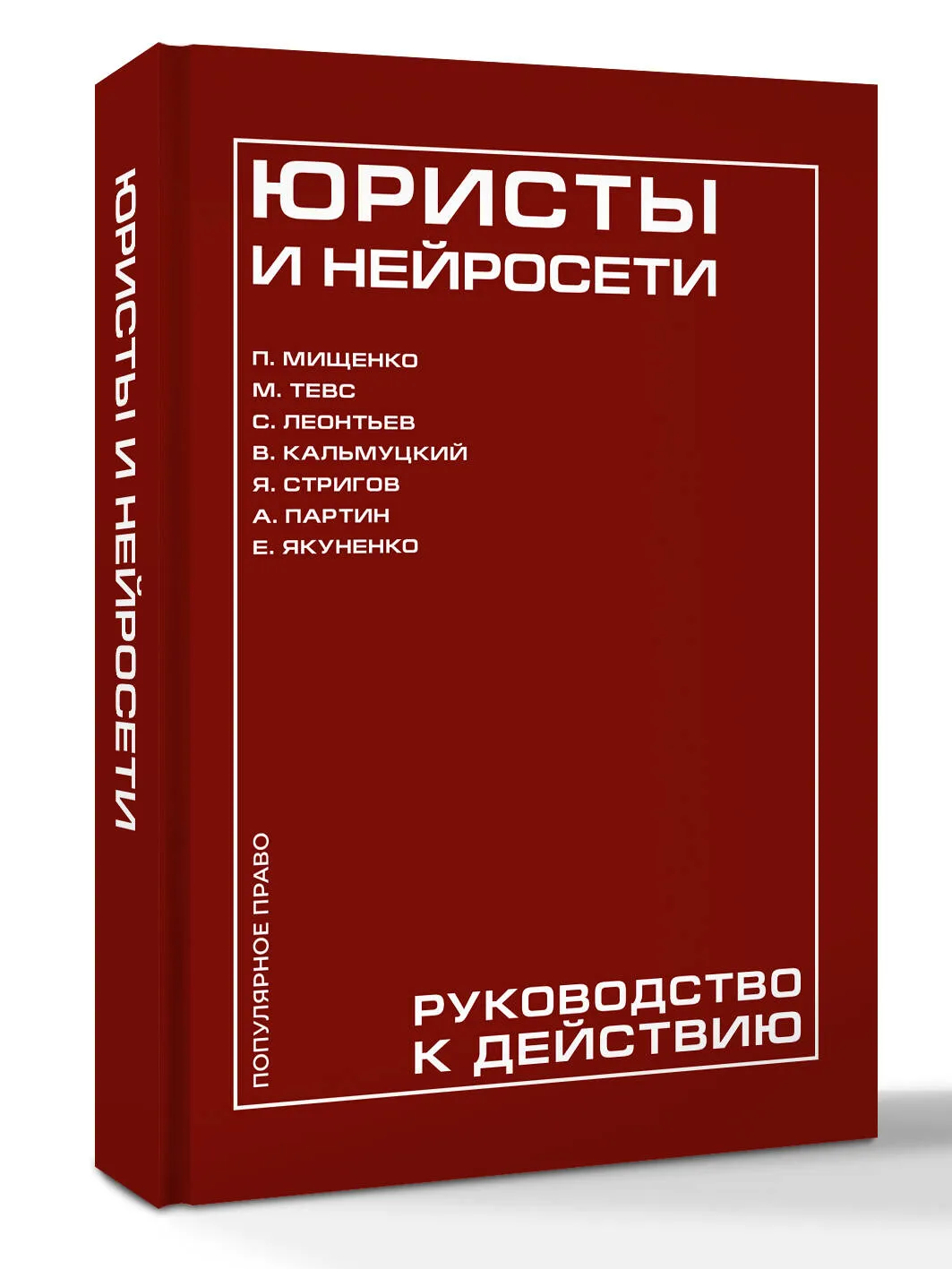
A collective guide to using AI in legal practice. I contributed the chapter on AI-assisted coding for lawyers. My chapter reflects an earlier generation of coding tools; the book also brings together the experience of fellow practitioners.
Conversations and public talks about legal AI, context engineering and learning by code building. Recordings and slides below are in Russian.

Selected talks & workshops
Managing context at different levels: from a conversation in the browser to an agent workspace.
With Pavel Mishchenko and Mikhail Tevs, I discussed how the book and the community knowledge base came together and answered questions from the audience.
A talk on using your own data with AI, alongside moderating a session on AI for specialised tasks.
I designed and teach a programme at the Institute of Legislation and Comparative Law under the Government of the Russian Federation. It covers how LLMs work and where they fail, choosing AI tools, designing tasks and agent workflows, managing context, knowledge and memory, and applying these methods to legal work — from document review and drafting to data extraction and monitoring.
I contribute to Runetlex Academy and other educational projects as a guest speaker, and mentor student projects at the intersection of law and AI.
I offer training and consultations on using LLMs and agents in legal work, knowledge management and building knowledge bases from a team’s own material.
I’m open to conversations and collaborations across these areas — from a shared research question to a talk, a workshop or a project.